How To Read a Skincare Ingredient List Like a Pharmacist
Have You Ever Picked Up Two Moisturizers and Wondered Which One Is Actually Better?
Standing in front of a pharmacy shelf can feel surprisingly overwhelming.
Two moisturizers may promise almost exactly the same thing. Both claim to hydrate, support the skin barrier and leave your skin feeling soft.
One costs $15.
The other costs $90.
So which one should you choose?
Most people start by looking at the front of the bottle. They notice words like natural, clean, dermatologist tested, anti-aging or luxury formula. Some automatically assume the more expensive product must be better. Others choose the brand they have seen most often on social media.
As a pharmacist, I approach skincare differently.
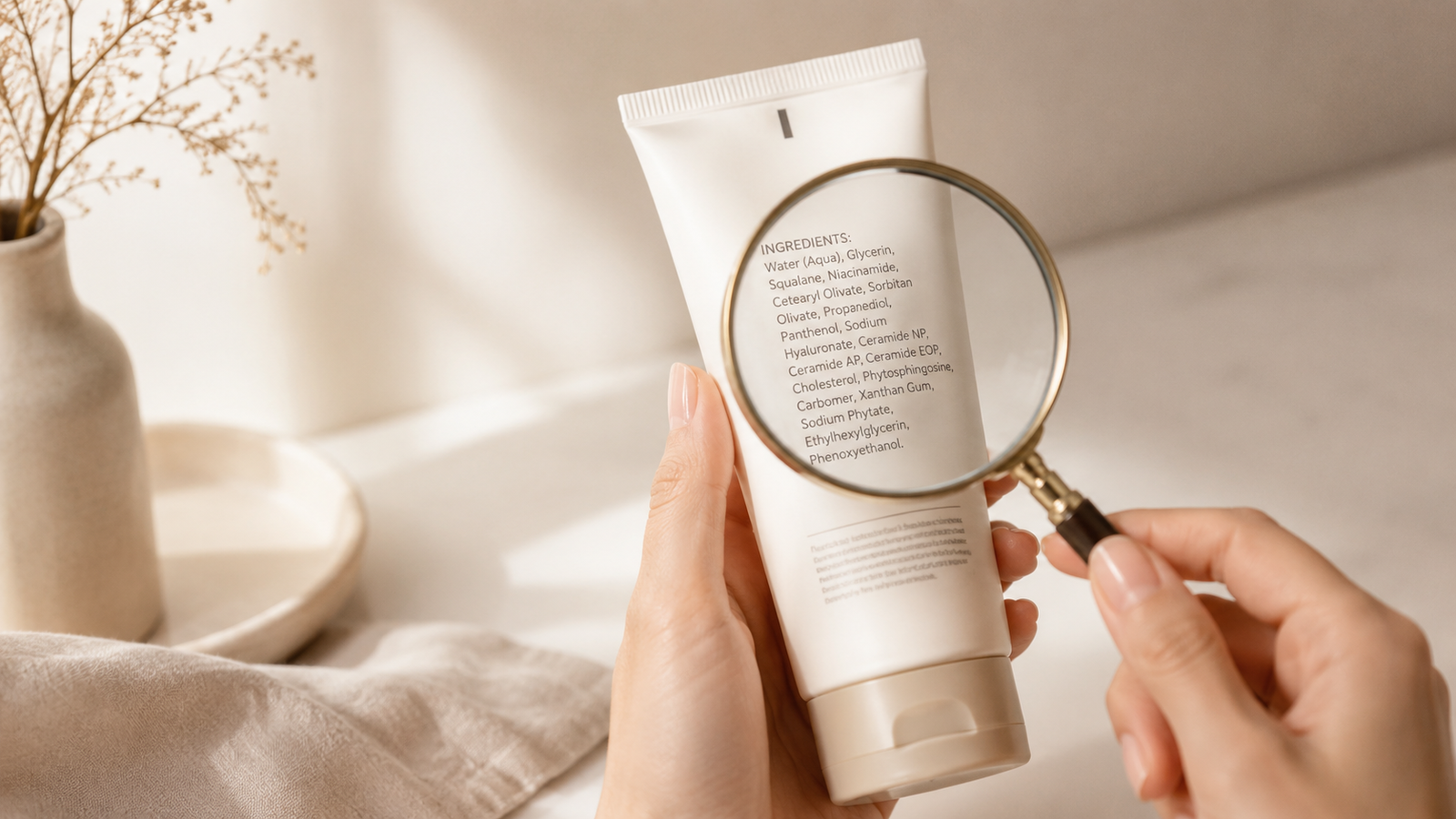
Before I look at the brand, before I look at the price and before I pay much attention to the marketing claims, I turn the product around.
Because some of the most useful information is on the back.
And one of the first things I look for is the ingredient list.
Learning how to read a skincare ingredient list will not turn you into a cosmetic chemist overnight. But it can help you shop more critically, understand what a product is built around and make choices that better match your skin's needs.
Why Skincare Labels Can Be So Confusing?
The skincare industry is very good at marketing.
Product packaging is filled with terms designed to grab your attention:
- Clean Beauty
- Natural
- Medical Grade
- Clinically Inspired
- Luxury Formula
- Dermatologist Tested
- Skin Loving
The problem is that an attractive claim on the front of a package does not automatically tell you how the entire product has been formulated.
Two creams can make very similar promises while containing very different formulas.
So instead of asking:
“Which product has the best marketing?”
I prefer asking:
“What is actually inside — and does it make sense for this skin?”
My Pharmacist Perspective
One of the most common questions people ask is:
“What’s the best moisturizer?”
And the answer is rarely one specific product.
Before recommending anything, I would rather know:
- What is your skin type?
- What are you trying to improve?
- Is your skin sensitive?
- Does it become dry or irritated easily?
- Are you already using ingredients such as retinoids or exfoliating acids?
Because skincare isn’t really about finding the best product.
It’s about finding the right product for your skin.
Once I understand that, then I start looking at the formula.
What Is an INCI List?
The ingredient list on a cosmetic product uses standardized ingredient names commonly referred to as INCI — International Nomenclature of Cosmetic Ingredients.
That is why a skincare label may contain names such as:
- Aqua
- Glycerin
- Butyrospermum Parkii Butter
- Niacinamide
- Panthenol
- Tocopherol
At first glance, it can look like another language.
In a way, that is exactly the point: standardized names allow the same ingredient to be identified consistently instead of relying on whatever commercial name a manufacturer prefers.
Once you learn a few basic patterns, the list becomes much less intimidating.
How to Decode INCI Names
You do not need to memorize hundreds of cosmetic ingredients.
Start with a few simple clues.
Botanical ingredients may appear under Latin names.
For example, plant-derived ingredients are often identified by their botanical name, which is one reason the ingredient list can look more complicated than it really is.
Many other ingredients appear under familiar scientific or English names, such as glycerin, niacinamide, panthenol or tocopherol.
Colorants may appear as CI numbers, which stands for Colour Index.
The goal is not to understand every single word on the label.
The goal is to recognize enough patterns to understand what kind of formula you are looking at.
The 1% Rule – and Why It Matters?
This is one of the most important things to understand when reading a cosmetic ingredient list.
Ingredients are generally listed in descending order of concentration until approximately the 1% level.
Below that level, ingredients may appear in a different order.
That means the ingredient list gives us useful clues, but it does not tell us the exact percentage of every ingredient.
If glycerin appears near the beginning of a moisturizer, you can reasonably understand that it is an important part of the formula.
But if niacinamide appears lower down, you cannot look at its exact position and confidently calculate its concentration.
This is also why I would never tell someone:
“Ingredient number seven is useless because it’s too low on the list.”
It simply isn’t that straightforward.
Some ingredients are designed to work at relatively low concentrations.
Others are used for preservation, texture, stability, fragrance or color.
Context matters.
Why I Look at the First Few Ingredients
Although an INCI list cannot tell us everything, the beginning of the list can still give us a useful first impression of the base of a product.
When I first pick up a moisturizer, I do not immediately analyze every ingredient from top to bottom.
I look at the first few.
I want to know:
What does this formula appear to be built around?
Is it mostly water and humectants?
Does it contain several emollients?
Does the formula look rich and occlusive?
Does it appear lighter?
Are there ingredients that might make me look more carefully if the person has very sensitive skin?
This is a screening tool — not a final verdict.
What the First Ingredients Can — and Can’t — Tell You
Imagine you’re comparing two moisturizers.
One begins like this:
Aqua, Glycerin, Caprylic/Capric Triglyceride, Cetearyl Alcohol, Ceramide NP
Another begins like this:
Aqua, Alcohol Denat., Fragrance, Colorants…
Without knowing the brand or the price, I would already have very different expectations.
The first formula suggests hydration, emollience and barrier support.
The second would make me look more carefully, especially if the product is intended for dry or sensitive skin.
But this is the important part:
You still cannot judge the entire quality of a product from the ingredient list alone.
An INCI list does not tell you:
- the exact concentration of every ingredient,
- the purity of the raw materials,
- how stable certain active ingredients are,
- how well the finished product will be tolerated,
- or how well the product performed in efficacy testing.
That is why an ingredient list is useful — but it is not the whole story.
Ingredients I Often Like to See in a Basic Moisturizer
There is no single ingredient that every person must have in their skincare routine.
But when I am evaluating a basic moisturizer, these are some ingredients I often like to see.
Glycerin
Glycerin is one of the most reliable humectants in skincare.
It helps attract water to the outer layers of the skin and supports hydration.
Ceramides
Ceramides are naturally found in healthy skin and help support the skin barrier and reduce moisture loss.
They can be especially useful in products designed for dry, sensitive or compromised skin.
Panthenol
Panthenol, also known as provitamin B5, is commonly used for its hydrating and soothing properties.
It is an ingredient I often notice in products designed for skin that feels irritated, tight or uncomfortable.
Niacinamide
Niacinamide is one of the most versatile ingredients used in skincare.
Depending on the formulation, it may help support the skin barrier, improve uneven skin tone, regulate excess oil and reduce the appearance of redness.
Squalane
Squalane is a lightweight emollient that helps soften the skin and reduce water loss.
It often feels comfortable even on combination skin.
One “Hero Ingredient” Does not Tell The Whole Story
A common mistake is assuming that one popular ingredient automatically makes a product effective.
It doesn’t.
A moisturizer containing ceramides is not automatically better than one without them.
Likewise, a product containing hyaluronic acid is not automatically the best choice.
What really matters is the entire formulation:
- Are the ingredients well balanced?
- Is the formula appropriate for your skin type?
- Do the ingredients work well together?
- Is the product designed to solve your specific concern?
As a pharmacist, I always look at the complete picture — not just the ingredient highlighted on the front of the bottle.
Pharmacist Tip
Don’t buy a product just because it contains one popular ingredient.
The best skincare products are not built around one “star ingredient” alone — they are built around a well-formulated combination of ingredients that work together.
Marketing Claims I Take With a Grain of Salt
This does not mean every marketing claim is false.
It means I do not use the claim alone to decide whether a product deserves my money.
Natural
Natural does not automatically mean safer, gentler or more effective.
Plants can contain useful compounds.
They can also contain substances capable of causing irritation or allergic reactions.
So instead of asking:
“Is this natural?”
I prefer asking:
“Is this formulation appropriate for this person’s skin?”
Clean Beauty
“Clean” sounds reassuring.
But it is much more useful to evaluate the actual ingredients and formulation than to assume that a broad marketing term guarantees product quality.
Different brands may use these terms differently, which makes them much less useful than they initially appear.
Free From…
“Paraben-free.”
“Preservative-free.”
“Fragrance-free.”
These claims can sometimes be useful, especially if you have a specific ingredient you need to avoid.
But the word “free” does not automatically mean “better.”
Dermatologist Tested
This sounds reassuring, but it should not end your evaluation.
The phrase alone does not tell you:
- how large the test was,
- what type of consumers were included,
- whether your skin type was represented,
- or whether the product performed better than another option.
Useful information?
Potentially.
Proof that it is the best product for your skin?
No.
Expensive Doesn’t Automatically Mean Better
This question comes up all the time:
“Isn’t the expensive one better?”
Sometimes a higher price may reflect something meaningful.
But price can also reflect:
- packaging,
- branding,
- advertising,
- prestige,
- product positioning.
That is why I would never recommend a moisturizer based on price alone.
There are affordable products with very sensible formulations.
There are luxury products with good formulations too.
And there are products at both ends of the price spectrum that simply may not suit your skin.
The goal is not to buy the cheapest product.
And it is not to buy the most expensive product.
The goal is to buy the one that makes sense for you.
My 30-Second Pharmacist Label Check
When I’m standing in front of a shelf, I don’t spend twenty minutes analyzing every ingredient.
I do a quick first screening.
Step 1 — Ignore the front for a moment
Turn the bottle around.
Step 2 — Look at the beginning of the ingredient list
Ask yourself:
“What is this formula mainly built around?”
Do not try to estimate exact percentages from ingredient position.
Step 3 — Look for ingredients relevant to your goal
Dry skin?
Look for a formula designed around hydration, emollience and barrier support.
Sensitive skin?
Think about simplicity, tolerability and barrier support.
Oily skin?
Consider whether the overall texture and formulation seem appropriate for what you actually enjoy wearing.
Step 4 — Look for ingredients you already know you don’t tolerate
Individual experience matters.
A perfectly acceptable cosmetic ingredient can still be inappropriate for one specific person.
Step 5 — Now go back to the front of the bottle
Read the claims.
Then ask yourself:
“Does the rest of the product give me a reasonable reason to believe them?”
That’s the order I prefer.
Not marketing first.
Context first.
Don’t Forget the Rest of the Label
The ingredient list is not the only useful information on cosmetic packaging.
Depending on the product and market, the label may also include:
- product function,
- precautions for use,
- batch identification,
- minimum durability or Period After Opening,
- and the ingredient list itself.
One symbol I always pay attention to is the small open jar marked with something like:
- 6M
- 12M
- 24M
This is the Period After Opening, or PAO.
It tells you how long the product is intended to remain suitable for use after opening, when stored and used appropriately.
It may not be as exciting as the ingredient list, but it is part of reading a product properly.
Behind the Pharmacy Counter
One conversation has stayed with me for years.
A customer once held two moisturizers.
One cost almost five times more than the other.
She smiled and asked:
“The expensive one must be better… right?”
Instead of answering immediately, I turned both bottles around.
We compared the ingredient lists together.
Within a minute, she realised something surprising.
The less expensive moisturizer contained nearly everything her dry skin actually needed.
She left with the product that suited her skin — not the one with the higher price tag.
Moments like this remind me why learning to read skincare labels is so valuable.
The goal isn’t to buy the most expensive product.
It’s to buy the right product.
The Glow Pharmacist Takeaway
Next time you’re choosing between two skincare products, don’t start with the price tag.
Don’t start with the influencer recommendation.
And don’t start with the biggest word printed on the bottle.
Turn it around.
Read the ingredient list.
Use it to understand what the formula appears to be built around — but remember that an INCI list cannot tell you everything about a product.
You do not need to memorize every ingredient.
You do not need to be afraid of long chemical names.
And you do not need to chase every trending “hero ingredient.”
The goal is simply to ask better questions and choose skincare that makes sense for your skin, your needs and your routine.
Because the best skincare purchase is not necessarily the most expensive one.
It is the one that is right for you.
Sources & Further Reading
- Giordano-Labadie F. Cosmetic products: learning to read labels. European Journal of Dermatology. 2012;22(5):591–595. doi:10.1684/ejd.2012.1786.
- Lionetti N, Rigano L. Labeling of Cosmetic Products. Cosmetics. 2018;5(1):22. doi:10.3390/cosmetics5010022.
- Regulation (EC) No 1223/2009 on cosmetic products.
This content is for educational and informational purposes only and is not a substitute for individualized medical advice.