
How to Choose Hair Oil for Your Hair Type
Choosing the right hair oil for your hair type can make the difference between soft, healthy-looking hair and greasy, weighed-down strands.
Have you ever bought a hair oil because everyone online seemed obsessed with it — only to find that your hair looked flatter, greasier, or somehow even drier?
The problem may not be hair oil itself.
You may simply be using the wrong oil for your hair.
Hair oils are often talked about as if they all do the same thing: add shine, reduce frizz, soften dry ends, and maybe even help with hair growth.
But they do not all behave in the same way.
Different oils have different fatty acid profiles and molecular characteristics, which influence how they interact with the hair. Some can penetrate the hair fibre to a greater extent, while others mostly remain on the surface and act as lubricants and emollients.
And both can be useful — depending on what your hair actually needs.
Coconut oil, for example, is one of the better-studied hair oils and has been shown to penetrate the hair shaft and help reduce protein loss. Other oils may work mainly by coating and smoothing the hair, making it look shinier and feel softer.
So instead of asking:
“What is the best hair oil?”
A better question is:
“What do I actually want this oil to do for my hair?”
That is exactly what we are going to figure out.
Why Hair Oil Isn’t One-Size-Fits-All
Think about hair oil the same way you think about a moisturizer.
A rich, heavy cream may feel perfect on very dry skin — and completely wrong on oily skin. Hair oils can behave in a similar way.
The reason is simple: oils are not chemically identical.
Most plant oils are largely made up of triglycerides and fatty acids, but the type and proportion of those fatty acids influence how an oil behaves on the hair. Some oils are better able to penetrate the hair fibre, while others mainly stay on the surface, where they help lubricate and smooth the strands.
That difference can completely change how an oil feels in your hair.
Coconut oil is a good example. Its fatty acid composition, particularly its high lauric acid content, helps explain why it can penetrate the hair shaft more effectively than many other oils. Research has also linked coconut oil with reduced protein loss from the hair.
Other oils may work more on the surface, helping to reduce friction, improve softness and add shine.
And that is not a weakness.
Sometimes your hair does not need an oil to penetrate deeply. Sometimes what you actually want is smoother ends, less frizz and a little more shine.
This is why the same hair oil can become someone’s holy grail — and someone else’s greasy disaster.
The goal is not to find the “best” oil.
It is to find the oil that matches your hair, your routine and what you want the oil to do.
How to Choose a Hair Oil Based on Your Hair Type
This is where choosing a hair oil becomes more personal.
The same oil can behave very differently depending on the thickness of your strands, how dry or damaged your hair is, and whether your main concern is the hair itself or the scalp.
A heavier oil may feel nourishing on dry, coarse hair but make fine hair look flat within minutes. A lighter oil may be perfect for smoothing fine ends, while very dry or damaged hair may benefit from something with a different fatty acid profile and greater ability to interact with the hair fibre.
Texture matters, too.
Some oils mainly coat the surface of the hair, helping to improve shine and reduce friction. Others, such as coconut oil, can penetrate the hair shaft to a greater extent.
So rather than choosing an oil based on popularity, start with the way your own hair behaves.
Let’s break it down.
Fine Hair
If your hair gets weighed down easily, you probably already know that “more oil” does not mean “better hair.”
Fine hair usually needs a lighter touch.
Thick, heavy oils can make the lengths look flat or greasy very quickly, especially if they are applied too close to the roots. In this case, the goal is usually not to saturate the hair, but to add a little softness and shine without sacrificing movement.
Almond oil can be a useful option here. It is relatively lightweight, contains oleic and linoleic acids, and has been described as having a non-greasy after-feel, which can make it more suitable for finer hair types.
The trick is the amount.
Start with just one or two drops, warm them between your palms, and apply only to the mid-lengths and ends. You can always add more, but once fine hair looks oily, it is difficult to undo without washing it again.
And if your roots already become oily quickly?
Skip the scalp completely.
For fine hair, a tiny amount in the right place usually works much better than a generous application everywhere.
Dry or Coarse Hair
If your hair often feels rough, dry or difficult to smooth, this is where richer oils can make more sense.
The goal here is usually to improve softness, reduce friction and help the hair feel more manageable.
Coconut oil is one of the most interesting options because it does more than simply sit on the surface. Its structure allows it to penetrate the hair shaft, and research has linked it with reduced protein loss from the hair.
Argan oil behaves differently. It is rich in oleic and linoleic acids, as well as tocopherols and squalene, and is mainly valued for its emollient and smoothing effect. It can help coat the cuticle, improve shine and reduce frizz rather than deeply penetrate the hair fibre.
Olive oil is another more emollient option. It mainly works by coating the hair and helping to seal the cuticle, although coconut oil appears to be more effective when it comes to penetrating the hair shaft.
So if your hair feels very dry or coarse, you do not necessarily need the “lightest” oil.
You may benefit more from an oil that provides a richer coating or, in the case of coconut oil, greater interaction with the hair fibre itself.
The important part is to match the oil to what your hair actually needs — softness, surface smoothing, or deeper protection of the strand.
Curly or Textured Hair
With curly or textured hair, the question is often less about “Which oil is the most nourishing?” and more about:
“What do I want the oil to do?”
If your main goal is smoother curls, less frizz and more shine, an oil that forms a light film over the hair can be useful.
Argan oil is a good example. Rather than penetrating deeply into the hair fibre, it primarily coats the cuticle. That surface effect can help improve gloss, reduce frizz and make the hair feel smoother.
Coconut oil plays a different role.
Because it can penetrate the hair shaft to a greater extent, it may make more sense as a pre-wash treatment when the goal is to protect the hair fibre and reduce protein loss rather than simply add shine after styling.
This is an important distinction.
You do not necessarily need to choose one oil and use it for everything.
You might use coconut oil before washing and a much smaller amount of argan oil afterwards to smooth the lengths and ends.
Think of it as two different jobs:
Coconut oil for deeper hair-fibre protection.
Argan oil for surface smoothing, shine and frizz control.
And with any oil, start small.
A few drops may be enough to change how the hair looks and feels without leaving it coated or heavy.
Oily Hair and Scalp
If your scalp becomes oily quickly, adding more oil can feel like the last thing you would want to do.
And in many cases, the smartest approach is simply to separate your scalp from your lengths.
Your scalp and your hair ends do not always need the same thing.
The scalp produces sebum naturally, while the lengths — especially if they are longer, colored or heat-styled — may still feel dry. That means you can keep oil away from the roots and use a very small amount only where the hair actually needs softness or shine.
Argan oil may be particularly interesting here. One review describes it as having a sebostatic effect, meaning it may have a regulatory influence on sebum secretion, although the evidence is still much more limited than the marketing around hair oils often suggests.
The practical takeaway is simple:
If your scalp gets oily fast, do not feel that you have to oil your roots just because scalp oiling is popular online.
Use oil where it helps.
For many people with oily roots, that may mean just the mid-lengths and ends.
And again, start with less than you think you need.
The Most Popular Hair Oils — and What They Actually Do
Hair oils are surrounded by big promises.
“Repairs damage.”
“Stops hair loss.”
“Boosts growth.”
“Deeply nourishes.”
“Transforms dry hair overnight.”
But the evidence is not equally strong for every oil — or for every claim.
Scientific reviews point out that many traditional and commercial claims about hair oils are still supported by limited evidence, even though oils can absolutely have useful cosmetic effects on the hair.
For most oils, the clearest benefits come from their emollient and lubricating properties: helping the hair feel softer, reducing friction between strands, smoothing the cuticle and improving shine.
Some oils, however, have characteristics that make them more interesting for specific purposes.
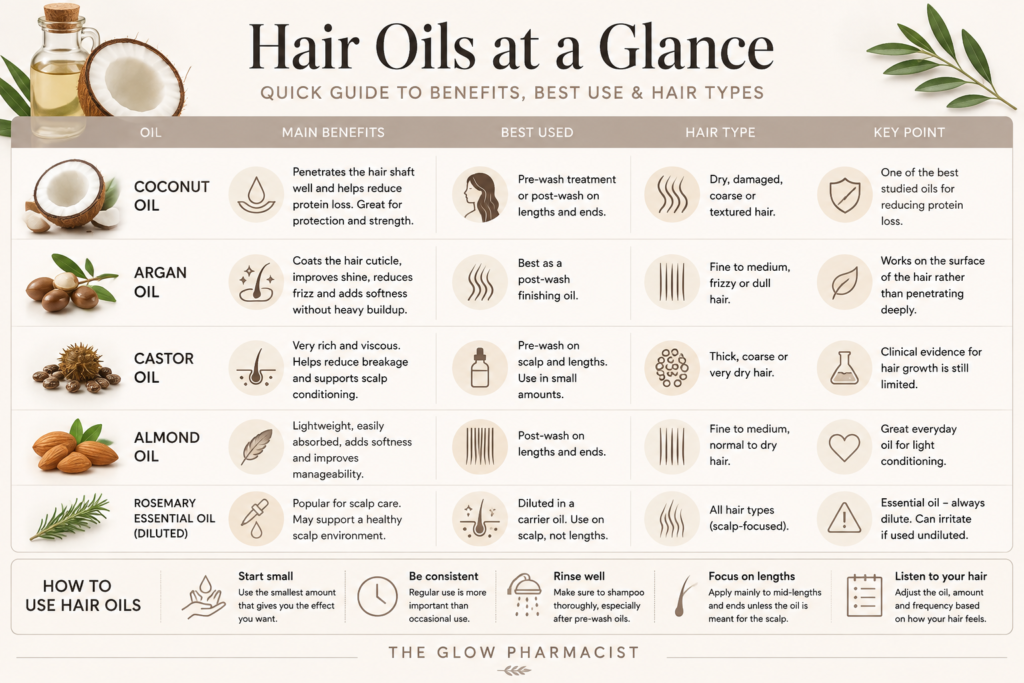
Coconut oil is particularly well studied for its ability to penetrate the hair shaft and reduce protein loss. Argan oil is better known for surface smoothing and shine. Other oils may be useful mainly because of their texture, fatty acid composition or ability to coat and soften the hair.
So instead of asking whether an oil is “good” or “bad,” let’s look at what each one is actually best at — and where the science becomes less convincing.
Coconut Oil — The One That Actually Penetrates the Hair Shaft
Coconut oil is probably one of the most talked-about hair oils online.
But unlike many viral hair claims, this one actually has some solid science behind it.
What makes coconut oil different is its fatty acid profile, especially its high content of lauric acid. Because of its relatively low molecular weight and straight-chain structure, coconut oil can penetrate into the hair shaft more effectively than many other oils.
That matters because hair is made largely of keratin proteins, and repeated washing, heat styling, coloring and mechanical stress can gradually contribute to protein loss and structural damage.
Coconut oil has been shown to help reduce that protein loss.
It also works on the surface of the hair, where it can improve slip between strands, help flatten the cuticle and make the hair feel smoother and easier to detangle.
So coconut oil has two interesting roles:
It can help protect the hair fibre from within.
And it can also improve softness and manageability on the surface.
This makes it especially useful as a pre-wash treatment for dry, damaged or coarse hair.
But there is one important catch.
Coconut oil can feel too heavy on fine hair, especially if you use too much or apply it close to the roots.
So if your hair is fine, start with a small amount and focus mainly on the lengths and ends.
Pharmacist Takeaway
Coconut oil is not magical — but among popular hair oils, it is one of the better-supported options when the goal is reducing protein loss and protecting the hair shaft.
Argan Oil — Shine, Smoothness and Frizz Control
Argan oil is often marketed as a “liquid gold” for hair.
And while that name is definitely more marketing than science, argan oil does have a useful role — especially if your goal is smoother, shinier-looking hair rather than deeper penetration into the hair shaft.
Argan oil is rich in oleic and linoleic acids and also contains compounds such as tocopherols and squalene.
Unlike coconut oil, it does not appear to penetrate the hair fibre to the same extent.
Instead, it mainly works on the surface.
By coating the cuticle, argan oil can help improve gloss, reduce frizz and make the hair feel softer and more polished.
That makes it a particularly practical option for post-wash use.
A few drops applied to the mid-lengths and ends can help smooth the hair without the heavier feel that some richer oils can leave behind.
This is also why argan oil can work well for people who want visible shine and softness but do not necessarily need an intensive pre-wash treatment.
The key is not to overdo it.
Even a lightweight-feeling oil can make the hair look greasy if too much is applied.
Pharmacist Takeaway
Think of argan oil more as a finishing and smoothing oil than a deep-penetrating treatment.
If your main concerns are frizz, dullness and rough-feeling ends, this is where argan oil makes the most sense.
Almond Oil — Lightweight Softness for Fine or Dry Hair
Almond oil does not get as much attention as coconut or argan oil, but it can be a very practical option — especially if your hair gets weighed down easily.
It contains a mix of fatty acids, including oleic and linoleic acid, as well as vitamin E.
Unlike coconut oil, almond oil does not appear to penetrate the hair shaft to the same extent. Its role is more about softening the hair, improving elasticity and helping dry strands feel smoother.
That makes it especially interesting for fine or mildly dry hair that needs softness without a very heavy coating.
Because it is generally lighter in feel, almond oil can also work well as a small finishing oil on the ends.
The key is still the amount.
Fine hair usually needs only a few drops. If you apply too much, even a lighter oil can quickly make the hair look flat or greasy.
Pharmacist Takeaway
Almond oil is a good “middle ground” option: lighter than many rich oils, useful for softness and shine, and easier to use on fine hair when applied sparingly.
Olive Oil — Richer, Heavier and Best Used With Restraint
Olive oil is one of those ingredients that sounds instantly nourishing.
And for dry, coarse or very textured hair, that richer feel can sometimes be exactly what you want.
Olive oil mainly works as an emollient. It coats the hair, helps smooth the cuticle and can reduce that rough, dry feeling by creating a more protective surface layer.
But compared with coconut oil, it is not considered as effective at penetrating the hair shaft.
That means its strength is more about surface softness and coating than deeper interaction with the hair fibre.
For very dry hair, that can still be useful.
For fine hair, however, olive oil can feel too heavy very quickly.
This is why olive oil makes the most sense when used in small amounts or as a pre-wash treatment rather than something you apply generously every day.
Think of it as a richer option for hair that really needs softness — not a universal oil for everyone.
Pharmacist Takeaway
Olive oil is best suited to dry, coarse or textured hair that benefits from a heavier emollient layer.
If your hair is fine, flat or becomes greasy easily, this is probably not the first oil I would reach for.
Castor Oil — Thick, Popular and Often Overhyped for Hair Growth
Castor oil has probably one of the biggest reputations in the hair-oil world.
It is thick, sticky, intensely coating — and constantly promoted as a natural way to make hair grow faster.
But this is where the marketing gets louder than the evidence.
Castor oil is rich in ricinoleic acid, which gives it its characteristic thick texture and contributes to its moisturizing and lubricating properties.
That can make it useful for dry ends or as part of a pre-wash treatment, especially when you want a more occlusive oil that helps reduce friction and leaves the hair feeling coated and softer.
What about hair growth?
There is a proposed mechanism involving ricinoleic acid and prostaglandin D2 synthase, a pathway that has been studied in relation to hair loss.
But a possible mechanism is not the same thing as proven hair growth in real people.
Clinical trials showing that castor oil reliably stimulates hair growth are still lacking.
So if you enjoy castor oil because it makes your hair feel softer or more protected, that is perfectly reasonable.
Just do not expect it to behave like a clinically proven hair-growth treatment.
Pharmacist Takeaway
Castor oil makes more sense as a thick, moisturizing and lubricating oil than as a miracle hair-growth product.
For most people, the cosmetic benefits are much better supported than the growth claims.
Rosemary Oil — Promising, but Not the Same as a Carrier Oil
Rosemary oil is everywhere in hair-growth content right now.
But there is one important thing to understand before you use it:
Rosemary oil is not the same type of product as coconut, argan or olive oil.
It is an essential oil.
That means it is much more concentrated, more volatile, and generally used in much smaller amounts than carrier oils.
In hair-care formulations, essential oils such as rosemary are typically added in low concentrations because they can irritate the skin if used too strongly.
So applying pure rosemary essential oil directly to the scalp is not the same as using a regular hair oil on the lengths.
And this distinction matters.
Rosemary oil is often marketed for hair growth, but the sources we are using here do not provide enough strong clinical evidence for us to treat that claim as settled.
What they do support is that rosemary is used in hair-care blends for scalp-focused purposes, while also reminding us that essential oils come with a higher irritation potential than standard carrier oils.
Pharmacist Takeaway
Treat rosemary oil as an active essential oil, not as an everyday carrier oil.
If you want to use it on the scalp, dilution matters — and so does realistic expectation.
For a strong hair-growth claim, we would need a dedicated clinical study rather than relying on marketing or tradition.
Pre-Wash vs Post-Wash Hair Oil: What’s the Difference?
When you use a hair oil can matter almost as much as which oil you choose.
A pre-wash oil and a post-wash oil are not really doing the same job.
Before shampooing, the goal is usually protection.
An oil applied through the lengths before washing can help reduce friction, improve lubrication and, depending on the oil, interact with the hair fibre itself. Coconut oil is particularly interesting here because research has shown that it can reduce protein loss when used before washing.
After washing, the goal is usually different.
You are often looking for softness, shine, smoother ends and less frizz.
This is where a lighter surface-acting oil can make more sense. A small amount of argan oil, for example, can coat the cuticle and improve gloss without needing to penetrate deeply into the hair shaft.
So think of it this way:
Pre-wash oil = protection and conditioning before shampoo.
Post-wash oil = smoothing, shine and finishing after shampoo.
And one oil can sometimes do both.
Coconut oil has been shown to reduce protein loss in both pre-wash and post-wash use, although the way it feels on the hair may still determine which method works better for you.
Pharmacist Takeaway
Use timing strategically.
If your hair is dry, damaged or coarse, a pre-wash oil treatment may be more useful.
If your main goal is shine, softness or frizz control, a few drops after washing may be all you need.
How Much Hair Oil Should You Use?
With hair oil, more is not automatically better.
In fact, using too much is one of the easiest ways to turn a useful product into something that leaves your hair looking flat, heavy or greasy.
There is no single “correct” amount that works for everyone.
How much you need depends on your hair length, density, strand thickness, the type of oil you are using and whether you are applying it before or after washing.
A thick oil such as castor oil will behave very differently from a lighter oil such as almond or argan oil.
So rather than following a fixed number of drops, start with the smallest amount that gives you the effect you want.
For post-wash use, that may mean just enough to lightly coat the mid-lengths and ends.
For a pre-wash treatment, you may use more — but the goal is still to coat the hair, not soak it until it is dripping.
A useful rule is simple:
If your hair looks greasy instead of smoother, you probably used more than you needed.
Fine hair usually needs less.
Dry, coarse or very textured hair may tolerate more.
And if you are trying a new oil for the first time, always start small. You can add more much more easily than you can remove it.
Pharmacist Takeaway
The right amount of hair oil is not a fixed number.
It is the smallest amount that gives your hair softness, smoothness or protection without making it feel heavy.
Common Hair Oiling Mistakes
Hair oiling is simple — but a few common mistakes can make it much less useful.
The first is assuming that every oil works the same way.
They do not.
Different oils vary in fatty acid composition, viscosity and how well they interact with the hair fibre. Coconut oil, for example, can penetrate the hair shaft more effectively than many other oils, while argan oil mainly works on the surface of the cuticle.
The second mistake is using more oil than your hair actually needs.
A very viscous oil such as castor oil can feel heavy quickly, while lighter oils may be easier to distribute through the lengths. The texture of the oil matters just as much as the amount.
Another common mistake is treating essential oils like regular carrier oils.
Rosemary, tea tree and lavender oils are concentrated essential oils and are usually used in small amounts in formulations because they can irritate the skin if used too strongly.
And perhaps the biggest mistake is believing every hair-growth claim you see.
Many oils are heavily marketed for thicker, faster-growing hair, but scientific reviews repeatedly point out that evidence for hair-growth stimulation is still limited for many popular oils.
That does not mean hair oils are useless.
They can still improve softness, lubrication, shine, manageability and protection of the hair fibre.
It simply means we should separate cosmetic benefits from claims that have not been well proven.
Pharmacist Takeaway
Use hair oils for what they are actually good at — and be cautious when marketing promises start sounding bigger than the evidence.
Can Hair Oil Help With Hair Growth?
This is probably the biggest question in the entire hair-oil conversation.
And the answer is not as exciting as social media often makes it sound.
Hair oils can absolutely improve the condition and appearance of the hair.
They can reduce friction, make strands easier to manage, improve softness and shine, and — in the case of coconut oil — help reduce protein loss from the hair fibre.
But protecting the hair shaft is not the same thing as stimulating a hair follicle to produce more hair.
That distinction matters.
Many oils, including castor oil and traditional herbal oil blends, are widely promoted for faster or thicker hair growth. Some laboratory or traditional evidence suggests possible biological mechanisms, but strong clinical evidence in humans is still limited for many of these claims.
Castor oil is a good example.
Ricinoleic acid has been proposed to interact with a pathway associated with hair loss, but clinical trials demonstrating that castor oil reliably promotes hair growth are lacking.
The same caution applies to many botanical oils and extracts marketed specifically for growth.
Promising does not mean proven.
So if an oil makes your hair feel healthier, softer and easier to manage, that is a real cosmetic benefit.
Just be careful not to turn that benefit into a claim the evidence cannot support.
Pharmacist Takeaway
Hair oils are much better established for conditioning and protecting the hair fibre than for stimulating new hair growth.
If significant hair thinning or hair loss is the concern, an oil should not automatically be treated as a substitute for finding the underlying cause and choosing an evidence-based approach.
The Glow Pharmacist’s Quick Guide to Choosing a Hair Oil
If you have made it this far and still feel unsure which oil fits your hair best, start with one question:
What do you want the oil to do?
For fine hair:
Choose a lighter oil and use a very small amount. Almond or argan oil may be easier to work with than heavier oils.
For dry, coarse or textured hair:
Coconut or olive oil may provide more noticeable softness and protection, especially when used before washing.
For frizz and shine:
Argan oil makes the most sense as a finishing oil because it mainly coats and smooths the hair surface.
For damaged hair:
Coconut oil has some of the strongest evidence for reducing protein loss and protecting the hair fibre.
For oily roots but dry ends:
Keep oil away from the scalp and apply a small amount only to the mid-lengths and ends.
For scalp-focused products:
Remember that essential oils such as rosemary are not the same as carrier oils. They are more concentrated and should be used carefully in properly diluted formulations.
For hair growth:
Be skeptical of dramatic promises. Most hair oils are better supported for conditioning, smoothing and protecting the hair than for actually stimulating new growth.
Pharmacist Takeaway
The best hair oil is not the most expensive, the most viral or the one with the biggest list of claims.
It is the one that matches your hair type, your routine and the result you are actually trying to achieve.
Final Thoughts
Hair oil does not have to be complicated.
The biggest mistake is choosing one because it is trending and then expecting it to solve every hair concern at once.
Some oils are better at penetrating the hair fibre.
Others are better at coating the surface, improving shine and reducing frizz.
Some feel light enough for fine hair, while others are much better suited to dry, coarse or textured hair.
And when it comes to hair growth, the evidence is still much less impressive than the marketing.
So before buying another oil, ask yourself what your hair actually needs.
Protection before washing?
Smoother ends?
More shine?
Less friction?
A scalp-focused product?
Once you know the goal, choosing the right oil becomes much easier.
And remember: healthy-looking hair is rarely the result of one “miracle” ingredient.
It is usually the result of choosing products that make sense for your hair, using them consistently, and knowing which claims are supported by evidence — and which ones are mostly marketing.
That is the approach I would take as a pharmacist, too.
Sources & Further Reading
- Mysore V, Arghya A. Hair Oils: Indigenous Knowledge Revisited. International Journal of Trichology. 2022;14:84–90. doi:10.4103/ijt.ijt_189_20.
- Rele AS, Mohile RB. Effect of Mineral Oil, Sunflower Oil, and Coconut Oil on Prevention of Hair Damage. Journal of Cosmetic Science. 2003;54:175–192.
- Bhilane N, Borase H, Girase MV, Upasani SV. From Tradition to Technology: A Review of Natural Hair Oils in Hair Care. International Journal of Scientific Research and Technology. 2025;2(11):315–322. doi:10.5281/zenodo.17577878.
This content is for educational and informational purposes only and is not a substitute for individualized medical advice.