

Magnesium Supplements Explained: Which Type Is Best for What?
Walk into almost any supplement aisle and magnesium suddenly stops looking simple.
- Magnesium glycinate.
- Magnesium citrate.
- Magnesium oxide.
- Magnesium malate.
- Magnesium chloride.
And every bottle seems to promise something different.
With so many types of magnesium supplements available, choosing the right one can quickly become confusing.
One is marketed for sleep. Another for stress. Another for energy, muscle recovery or digestion.
But are these forms really that different?
Magnesium itself is an essential mineral involved in hundreds of biochemical reactions in the body, including processes related to nerve and muscle function, energy metabolism and bone health.
The confusing part is that magnesium supplements do not contain magnesium on its own.
The mineral is bound to another compound — such as citrate, glycinate, oxide or malate — and that form can influence things like absorption, elemental magnesium content and gastrointestinal tolerance.
But this is also where supplement marketing tends to oversimplify the science.
A form that is absorbed well is not automatically “best” for every purpose. And seeing “magnesium glycinate” on a label does not automatically mean you have found the perfect supplement for sleep.
So instead of ranking magnesium supplements by popularity, we are going to look at what the different forms actually are, what the evidence supports, and what matters most when you are choosing one.
Because the best magnesium supplement is not necessarily the trendiest one.
It is the one that makes sense for what you actually need.
Why Are There So Many Types of Magnesium?
Here is the first thing that makes magnesium supplements confusing:
The word “magnesium” on the front of the bottle does not tell you the whole story.
In supplements, magnesium is usually combined with another substance. That is why you see names such as magnesium citrate, magnesium glycinate, magnesium oxide or magnesium malate.
The second part of the name matters.
It can influence how the supplement behaves in the digestive tract, how well magnesium is absorbed, how much elemental magnesium the product actually provides and how likely it is to cause gastrointestinal side effects.
Take magnesium glycinate as an example.
In this form, magnesium is bound to the amino acid glycine. Chelated products may also combine magnesium with other compounds — one product in the literature, for example, contains both magnesium lysinate glycinate and dimagnesium malate.
But this does not mean that every form has a completely different job inside the body.
Once absorbed, magnesium is still magnesium.
The biggest practical differences between supplement forms are usually things like absorption, solubility, dose and tolerability — not a simple rule where one form belongs exclusively to sleep, another to stress and another to energy.
And there is another detail that matters even more than the impressive name on the front of the bottle:
How much elemental magnesium are you actually getting?
That number can be very different from the total weight of the magnesium compound.
We will come back to that shortly, because it is one of the most useful things to understand when comparing magnesium supplements.
Pharmacist Takeaway
Do not choose a magnesium supplement based on the name of the form alone.
The form matters — but so do absorption, gastrointestinal tolerance and the actual amount of elemental magnesium in each dose.
What Does “Elemental Magnesium” Actually Mean?
This is one of the most useful things to understand before comparing magnesium supplements.
When you see “magnesium citrate,” “magnesium glycinate” or “magnesium oxide” on a bottle, the entire weight of that compound is not pure magnesium.
Only part of it is actual magnesium.
That portion is called elemental magnesium.
And this is the number that matters when you are comparing how much magnesium a supplement really provides.
For example, a product may contain several hundred milligrams of a magnesium compound but provide a much smaller amount of elemental magnesium.
This is why two products can look very different on the front of the bottle but still provide a similar amount of magnesium per serving.
So when you read the label, do not focus only on the name of the magnesium form.
Look at the Supplement Facts panel and find the line that says “Magnesium.”
That is usually the amount of elemental magnesium provided per serving.
Then check the serving size.
Because 200 mg of magnesium per serving sounds straightforward — until you realize that one serving may mean two, three or even four capsules.
Pharmacist Takeaway
When comparing magnesium supplements, always compare the amount of elemental magnesium per serving — not just the total weight of the magnesium compound or the number printed on the front of the bottle.
Magnesium Glycinate — Is It Really the Best for Sleep and Stress?
Magnesium glycinate has become one of the most popular forms of magnesium — especially in products marketed for sleep, relaxation and stress.
But the marketing is a little more confident than the evidence.
In magnesium glycinate, magnesium is bound to the amino acid glycine. This creates a chelated form that is often promoted as being well absorbed and easier on the stomach than some other magnesium salts.
There is some evidence that magnesium chelates can be well tolerated, but that does not automatically mean magnesium glycinate is superior to every other form.
And what about sleep?
A 2025 randomized, double-blind, placebo-controlled trial looked at 155 adults with poor sleep quality who took either magnesium bisglycinate providing 250 mg of elemental magnesium per day or placebo for four weeks.
The magnesium group did improve more than the placebo group on an insomnia severity score.
But the effect was small.
That is an important detail, because it means we cannot simply translate the study into:
“Magnesium glycinate is the best magnesium for sleep.”
The study suggests that bisglycinate may provide a modest benefit for some people with poor sleep, but more research is still needed — particularly studies comparing glycinate directly with other magnesium forms.
The same caution applies to stress and anxiety claims.
Magnesium plays important roles in normal nervous-system function, but evidence that glycinate specifically is the best form for stress is much less convincing than supplement marketing often suggests.
Pharmacist Takeaway
Magnesium glycinate is a reasonable option if you want a well-tolerated magnesium supplement, and there is emerging evidence for a modest benefit in people with poor sleep.
But “best for sleep and stress” is still a stronger claim than the evidence currently supports.
Magnesium Citrate — Better Absorbed and Useful When Constipation Is Part of the Picture
Magnesium citrate is one of the better-studied forms of magnesium.
And unlike some supplement claims, there is a fairly solid reason for its popularity.
Magnesium citrate dissolves well in liquid, and studies comparing it with magnesium oxide have consistently found that citrate is more soluble and more bioavailable.
In other words, your body generally absorbs magnesium citrate more efficiently than magnesium oxide.
That makes citrate a practical option when the goal is simply to supplement magnesium.
But magnesium citrate has another effect that is worth knowing about.
Magnesium salts can draw water into the intestines, which is why some magnesium products are also used for their laxative effect.
For someone who already tends toward constipation, that may actually be useful.
For someone with a sensitive stomach or a tendency toward loose stools, it may be the exact opposite.
This is why “better absorbed” does not automatically mean “better for everyone.”
A supplement only works well if you can tolerate it consistently.
Pharmacist Takeaway
Magnesium citrate is one of the better-supported options when absorption matters, and it may be particularly practical if constipation is also a concern.
But if magnesium tends to loosen your stools, citrate may not be the most comfortable choice for you.
Magnesium Oxide — High in Elemental Magnesium, but There’s a Catch
Magnesium oxide is one of the most common forms you will find in supplements.
At first glance, it can look impressive because magnesium oxide contains a relatively high proportion of elemental magnesium by weight.
But there is an important catch:
A high elemental magnesium content does not necessarily mean that your body will absorb more of it.
Magnesium oxide is poorly soluble compared with forms such as magnesium citrate, and several studies have found lower bioavailability from magnesium oxide.
In one randomized trial comparing magnesium citrate, an amino-acid chelate and magnesium oxide, citrate and the chelated form produced greater magnesium absorption than oxide.
Another study comparing citrate and oxide found magnesium citrate to be substantially more soluble and to produce a greater increase in urinary magnesium after supplementation.
So does that make magnesium oxide useless?
Not necessarily.
It can still provide magnesium, and magnesium oxide is also commonly found in products used for digestive purposes because unabsorbed magnesium in the intestine can contribute to an osmotic laxative effect.
The important point is that the biggest number on the label does not always translate into the greatest amount of magnesium being absorbed.
Pharmacist Takeaway
Magnesium oxide may provide a lot of elemental magnesium on paper, but it is generally less bioavailable than forms such as magnesium citrate.
Do not judge a magnesium supplement by the milligram number alone.
Magnesium Malate — Is It Really Better for Energy and Muscle Fatigue?
Magnesium malate is another form that sounds especially appealing on supplement labels.
It is often marketed for energy, muscle function and fatigue.
The reason behind these claims is easy to understand.
Magnesium malate combines magnesium with malic acid, a compound that participates in the biochemical pathways involved in cellular energy production.
But there is an important difference between a biologically plausible explanation and a proven clinical benefit.
The fact that malic acid participates in energy metabolism does not automatically mean that taking magnesium malate will give you more energy or reduce everyday fatigue.
Research specifically testing magnesium malate is surprisingly limited.
Much of the clinical discussion comes from older studies in people with fibromyalgia, where combinations of magnesium and malic acid were investigated for symptoms such as pain and fatigue.
The results have not been particularly convincing.
A later evidence review concluded that magnesium combined with malic acid probably makes little or no difference to pain in people with fibromyalgia, and the available evidence is too limited to support strong claims about fatigue.
That does not mean magnesium malate is a bad supplement.
It simply means we should be careful with claims such as:
“Magnesium malate is the best magnesium for energy.”
At the moment, the evidence does not justify that statement.
Pharmacist Takeaway
Magnesium malate is a legitimate form of magnesium, but its reputation as the “energy magnesium” is based more on biochemical reasoning and marketing than strong clinical evidence.
Choose it because it is an acceptable magnesium formulation — not because you expect it to work like an energy booster.
Magnesium Chloride — A Well-Absorbed Form That Gets Less Attention
Magnesium chloride does not get nearly as much attention as glycinate or citrate.
But from an absorption standpoint, it deserves more credit than supplement marketing usually gives it.
In a comparative human study, magnesium chloride showed significantly better bioavailability than magnesium oxide and performed similarly to magnesium lactate and magnesium aspartate.
That is useful because it reminds us of something important:
You cannot judge magnesium absorption simply by dividing forms into “organic” and “inorganic.”
Magnesium chloride is an inorganic salt, yet it can still be absorbed well.
This is one reason simple rules such as “organic forms are always better” are not especially helpful when choosing a supplement.
Magnesium chloride is available in oral supplements, but it is also commonly found in topical magnesium products.
And that creates another question:
Does magnesium sprayed or rubbed onto the skin work as well as taking it orally?
The evidence for meaningful transdermal magnesium absorption is much less convincing than the evidence for oral supplementation, so topical magnesium should not automatically be considered an equivalent replacement.
Pharmacist Takeaway
Magnesium chloride is a well-absorbed oral form that is often overlooked.
Its good bioavailability also shows why the chemistry of a magnesium salt matters more than simply labeling it “organic” or “inorganic.”
Magnesium Lactate and Aspartate — Less Trendy, but Still Worth Knowing About
Magnesium lactate and magnesium aspartate rarely get the same attention as glycinate or citrate.
But “less popular” does not mean “poorly absorbed.”
In a human study comparing several magnesium preparations, magnesium lactate and magnesium aspartate both showed significantly better bioavailability than magnesium oxide.
Their absorption was similar to magnesium chloride in that study.
That is useful because it shows how misleading supplement trends can be.
A magnesium form does not need to be heavily marketed for sleep, stress or energy to be a reasonable option.
Sometimes the most important questions are much simpler:
Does the product provide an appropriate amount of elemental magnesium?
Is the form reasonably well absorbed?
Can you tolerate it without gastrointestinal problems?
And does it fit your individual needs?
Magnesium lactate and aspartate may not have the same marketing appeal as glycinate, but the available absorption data suggest that they should not be dismissed.
Pharmacist Takeaway
Magnesium lactate and magnesium aspartate are less fashionable than glycinate or citrate, but human absorption studies suggest that both can provide magnesium effectively.
Popularity is not the same thing as bioavailability.
Magnesium Taurate — Is It Really the “Heart-Friendly” Magnesium?
Magnesium taurate combines magnesium with taurine, an amino acid-like compound involved in several processes in the cardiovascular and nervous systems.
Because both magnesium and taurine have been studied separately for their potential cardiovascular effects, magnesium taurate is often marketed as the form of magnesium that is “best for the heart.”
The idea is biologically plausible.
But the clinical evidence for magnesium taurate itself is still limited.
Some experimental research has investigated magnesium acetyl taurate and suggests that it may have different absorption and tissue-distribution characteristics compared with other magnesium compounds.
However, much of this research has been performed in animals rather than humans.
A 2026 observational study also looked at a supplement containing magnesium taurate together with potassium citrate in adults with elevated blood pressure. Blood pressure and measures of arterial stiffness improved over three months.
But there is an important limitation:
The study did not test magnesium taurate alone, there was no placebo control group, and participants also received lifestyle counselling.
That means we cannot say that magnesium taurate itself caused the improvement.
So while magnesium taurate is an interesting formulation, calling it “the best magnesium for heart health” goes beyond what current evidence can support.
Pharmacist Takeaway
Magnesium taurate is a promising form, particularly from a cardiovascular research perspective, but human evidence is still limited.
At this point, “best for the heart” should be viewed as a marketing claim rather than an established clinical fact.
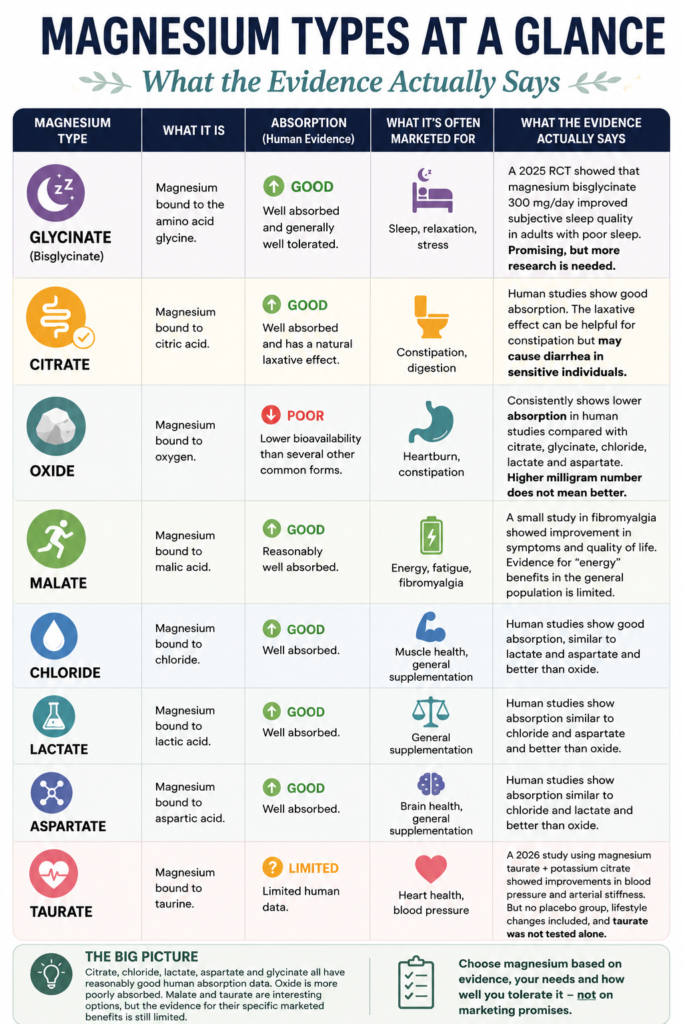
Types of Magnesium Supplements: Which Is Best for What?
After comparing the different forms, the answer is a little less exciting than supplement marketing would have you believe:
There is no single “best” magnesium for everyone.
The better choice depends on why you are taking it, how well you tolerate it and how much elemental magnesium the product actually provides.
Here is a practical way to think about it:
For general magnesium supplementation:
Magnesium citrate, chloride, lactate and aspartate all have reasonably good human absorption data.
For sleep:
Magnesium bisglycinate is a reasonable option, and newer research suggests it may modestly improve sleep in some people. But there is not enough evidence to say that glycinate is definitively the best form for sleep.
For constipation:
Magnesium citrate can be a practical choice because magnesium salts can draw water into the intestines and soften stool. This effect can also become an unwanted side effect if you are prone to diarrhea.
For people who want to avoid digestive upset:
Magnesium glycinate is commonly chosen because it tends to be well tolerated, although individual responses still vary.
For energy or fatigue:
Magnesium malate is frequently marketed for this purpose, but strong clinical evidence showing that it is specifically better for energy is lacking.
For cardiovascular health:
Magnesium taurate is interesting, but evidence that it is superior to other magnesium forms for heart health is still too limited to make that claim.
And magnesium oxide?
It contains a relatively high proportion of elemental magnesium, but its absorption is generally poorer than several other commonly used forms. It may still have a place, particularly when a laxative effect is useful, but it should not automatically be chosen simply because the milligram number on the label looks higher.
The most important lesson is this:
Choose magnesium based on evidence and your individual needs — not on a one-word marketing promise printed on the front of the bottle.
Pharmacist Takeaway
“Glycinate for sleep, citrate for constipation, malate for energy and taurate for the heart” is a useful marketing shortcut — but it is not an evidence-based rule.
The real differences between magnesium supplements are more nuanced.
How to Read a Magnesium Supplement Label
Once you know that different forms of magnesium are not interchangeable, the label becomes much easier to understand.
Here is what to check.
- Look for the amount of elemental magnesium
On the Supplement Facts panel, find the line that simply says “Magnesium.”
That is the amount of elemental magnesium provided per serving.
Do not confuse it with the total weight of magnesium citrate, glycinate, oxide or another compound.
- Check the serving size
A product may provide 200 or 300 mg of magnesium per serving, but one serving may equal two, three or even four capsules.
Always check how many capsules, tablets or scoops are needed to reach the listed dose.
- Look at the form
The label should also tell you which magnesium compound is being used.
You may see wording such as:
Magnesium (as magnesium citrate)
Magnesium (as magnesium bisglycinate)
Magnesium (as magnesium oxide)
Or even a combination of several forms.
The form can influence absorption and gastrointestinal tolerance, so it is worth checking.
- Do not assume a “blend” is automatically better
Some products combine several magnesium forms and market this as a major advantage.
But a blend is not automatically more effective.
What matters more is whether the product provides an appropriate amount of elemental magnesium, uses reasonable forms and is well tolerated.
- Check the rest of the formula
Magnesium products may also contain vitamin B6, zinc, potassium, herbs or other ingredients.
More ingredients do not necessarily make the supplement better.
If you only want magnesium, a simpler formula may actually make it easier to know exactly what you are taking.
Pharmacist Takeaway
When comparing magnesium supplements, check four things first:
The elemental magnesium dose, the serving size, the magnesium form and the rest of the ingredient list.
The front of the bottle is marketing.
The Supplement Facts panel is where the useful information is.
How Much Magnesium Do You Actually Need?
This is where magnesium labels can become confusing again.
The recommended daily amount of magnesium refers to magnesium from all sources — food, drinks and supplements combined.
For most adult women, the recommended intake is about 310–320 mg per day.
For most adult men, it is about 400–420 mg per day.
Pregnancy increases magnesium needs slightly, with recommended intakes generally around 350–360 mg per day for adult women.
But here is the part that often causes confusion:
The upper limit for magnesium from supplements and medications is 350 mg per day for adults.
That does not mean adults should get only 350 mg of magnesium in total.
The 350 mg upper limit applies specifically to supplemental magnesium — not magnesium naturally present in food.
For example, someone could get 250 mg of magnesium from food and another 200 mg from a supplement without exceeding the supplemental upper limit.
Why is there a separate limit for supplements?
Because higher supplemental doses are more likely to cause gastrointestinal side effects, especially diarrhea, nausea and abdominal cramping.
And more is not automatically better.
Your ideal supplemental dose depends on how much magnesium you already get from your diet, why you are taking it and whether a healthcare professional has recommended a particular dose.
Pharmacist Takeaway
Do not confuse the recommended daily intake with the upper limit for supplements.
Adults generally need around 310–420 mg of magnesium per day from all sources, while the 350 mg upper limit applies specifically to magnesium from supplements and medications unless a healthcare professional recommends otherwise.
Who Should Be Careful With Magnesium Supplements?
Magnesium supplements are generally well tolerated when used appropriately, but they are not completely risk-free.
The first group that needs extra caution is people with impaired kidney function.
The kidneys are responsible for removing excess magnesium from the body. When kidney function is significantly reduced, magnesium can accumulate and the risk of toxicity increases.
This is one reason people with kidney disease should not start high-dose magnesium supplements without medical guidance.
Medication interactions matter too.
Magnesium can reduce the absorption of some medications when they are taken too close together.
Two important examples are:
Bisphosphonates, which are used to treat osteoporosis.
Certain antibiotics, including tetracycline and quinolone antibiotics.
Depending on the medication, the doses may need to be separated by several hours.
Diuretics can also affect magnesium levels.
Some increase magnesium loss through the urine, while potassium-sparing diuretics may reduce magnesium excretion.
Long-term use of proton pump inhibitors, or PPIs, can also contribute to low magnesium levels in some people.
And finally, pay attention to your digestive system.
Too much supplemental magnesium can cause diarrhea, nausea and abdominal cramping. If that happens, the dose or the form of magnesium may need to be reconsidered.
Pharmacist Takeaway
Check before supplementing if you have kidney disease or take regular medication.
And if you use antibiotics, bisphosphonates, diuretics or long-term acid-suppressing medication, timing and monitoring may matter just as much as the type of magnesium you choose.
Do You Even Need a Magnesium Supplement?
Magnesium is essential, but that does not mean everyone needs a supplement.
For many people, food can provide a substantial amount of daily magnesium.
Good dietary sources include nuts, seeds, legumes, whole grains and green leafy vegetables.
Supplementation becomes more relevant when magnesium intake is consistently low, when absorption is impaired or when magnesium losses are increased.
Certain medications can also affect magnesium status.
But symptoms often blamed on “magnesium deficiency” — such as fatigue, muscle cramps or poor sleep — are not specific to magnesium.
That means they should not automatically be treated as proof that you need a supplement.
A supplement may be useful in the right situation, but it should not replace a good diet or a proper evaluation when symptoms are persistent.
Pharmacist Takeaway
Magnesium supplements can be useful, but they are not automatically necessary.
Start with the bigger picture: your diet, medications, health conditions and the reason you are considering supplementation in the first place.
Final Thoughts
Magnesium supplements are often marketed as if every form has one specific job.
Glycinate for sleep.
Citrate for digestion.
Malate for energy.
Taurate for the heart.
The reality is more nuanced.
Different forms can vary in absorption, solubility, elemental magnesium content and gastrointestinal tolerance. But many of the highly specific claims attached to individual forms are stronger than the clinical evidence behind them.
That does not mean the form is irrelevant.
It means the best choice depends on the whole product — not just the name printed on the front of the bottle.
Look at how much elemental magnesium you are actually getting.
Consider how well the form is absorbed and tolerated.
Think about why you are taking it in the first place.
And remember that a more expensive or trendier form is not automatically a better supplement.
From a pharmacist’s perspective, the best magnesium is not the one with the most impressive marketing claim.
It is the one that provides an appropriate dose, has reasonable evidence behind it, fits your individual needs and can be used safely and consistently.
Sources & Further Reading
- National Institutes of Health, Office of Dietary Supplements. Magnesium: Fact Sheet for Health Professionals. Updated 2026.
- Pardo MR, Garicano Vilar E, San Mauro Martín I, Camina Martín MA. Bioavailability of magnesium food supplements: A systematic review. Nutrition. 2021;89:111294. doi:10.1016/j.nut.2021.111294.
- Walker AF, Marakis G, Christie S, Byng M. Mg citrate found more bioavailable than other Mg preparations in a randomised, double-blind study. Magnesium Research. 2003;16(3):183–191.
- Firoz M, Graber M. Bioavailability of US commercial magnesium preparations. Magnesium Research. 2001;14(4):257–262.
- Schuster J, Cycelskij I, Lopresti A, et al. Magnesium Bisglycinate Supplementation in Healthy Adults Reporting Poor Sleep: A Randomized, Placebo-Controlled Trial. Nature and Science of Sleep. 2025;17:2027–2040. doi:10.2147/NSS.S524348.
- Ferreira I, Ortigoza Á, Moore P. Magnesium and malic acid supplement for fibromyalgia. Medwave. 2019;19(4):e7633. doi:10.5867/medwave.2019.04.7632.
- Dereli S. Effects of magnesium taurate-potassium citrate on blood pressure and vascular stiffness in low-risk adults with elevated blood pressure. Magnesium Research. 2026;38(4):118–125. doi:10.1684/mrh.2026.0552.
- Beckstrand RL, Pickens JS. Beneficial Effects of Magnesium Supplementation. Journal of Evidence-Based Complementary & Alternative Medicine. 2011;16(3):181–189. doi:10.1177/2156587211401746.
This content is for educational and informational purposes only and is not a substitute for individualized medical advice. Always speak with a healthcare professional before starting a new supplement, especially if you have a medical condition, impaired kidney function, are pregnant or breastfeeding, or take prescription medications.