
Night Shift Recovery: What Actually Helps After a Long Shift?
Finishing a night shift can leave you feeling strangely tired and wired at the same time.
Your body wants rest, but daylight is telling your brain that the day has started. You may feel hungry at unusual times, your sleep schedule can feel completely upside down, and reaching for another coffee may seem like the easiest way to keep functioning.
That is not simply a lack of willpower.
Night work asks your body to stay awake when its internal clock is naturally promoting sleep — and then asks you to sleep when that same clock is promoting wakefulness.
This mismatch is one reason night shift workers often sleep less and experience poorer-quality sleep than people who work during the day.
A good night shift recovery routine starts with understanding how sleep, light, caffeine and meal timing affect your body after working through the night.
And while social media is full of “night shift recovery routines,” not every popular tip is supported by good evidence.
Some strategies really can help.
The timing of sleep matters.
Light exposure matters.
Caffeine timing matters.
And even a well-planned nap can make a difference.
But recovery after a long shift is not about finding one perfect supplement or forcing yourself into a complicated routine.
It is about working with your circadian rhythm as much as your schedule allows.
In this guide, we will look at what research actually says about sleep, light, caffeine, naps, food and recovery after night shifts — and how to build a routine that is realistic enough to use in real life.
Why Night Shifts Feel So Hard on Your Body
Night shifts are difficult for a simple reason: your work schedule is asking your body to do the opposite of what its internal clock expects.
Your circadian rhythm is strongly influenced by the natural light-dark cycle.
During the night, your body is biologically prepared for sleep. During the day, light promotes alertness and makes daytime sleep more difficult.
That means a night shift creates two separate challenges.
First, you have to stay alert during the hours when your body naturally wants to sleep.
Then, when you finally get home, you have to sleep during the hours when your body is beginning to promote wakefulness again.
This is why night shift workers often sleep for fewer hours and report poorer-quality sleep than people who work during the day.
And the effects are not limited to feeling tired.
Sleep loss can also affect concentration, reaction time, memory and decision-making — which matters even more in healthcare and other jobs where mistakes can have serious consequences.
Your digestion can also feel “off” during a night shift because eating, sleeping and working are happening at unusual biological times.
Pharmacist Takeaway
Feeling exhausted after a night shift is not just about having had a busy day.
Your sleep-wake schedule is working against your circadian rhythm, so the first goal of recovery is to protect sleep as much as your schedule realistically allows.
What Should You Do Right After a Night Shift?
The hours immediately after a night shift matter more than many people realize.
Once your shift is over, the goal is not to squeeze in errands, chores or “one more thing” before bed.
The goal is to make the transition to sleep as easy as possible.
If you are hungry, have a small, light meal or snack before bed rather than a large, heavy meal.
Then keep things simple.
Lower the light around you.
Avoid unnecessary screen time if it keeps you alert.
Keep your bedroom as dark, quiet and cool as possible.
And try to get into bed reasonably soon after arriving home.
This matters because morning light sends a strong wake-up signal to your circadian system.
The longer you stay awake after a night shift, the more likely it is that your natural daytime alerting system will start working against you.
Caffeine matters too.
A coffee near the beginning of a night shift may help with alertness, but caffeine close to the end of the shift can still be active when you are trying to sleep several hours later.
So if daytime sleep is difficult, one of the first things worth looking at is not only how much caffeine you drink — but when you drink it.
Pharmacist Takeaway
After a night shift, think “protect sleep” rather than “finish the day.”
A short wind-down routine, less light, no late caffeine and getting to bed without unnecessary delays can make daytime sleep easier to protect.
How to Make Daytime Sleep Actually Work
Sleeping during the day is not the same as sleeping at night.
Your environment has to do more work for you.
The first priority is darkness.
Even small amounts of daylight can make it harder for your brain to stay in sleep mode, so blackout curtains or a good sleep mask can make a noticeable difference.
Noise matters too.
Daytime sleep is often lighter and easier to interrupt, so earplugs, white noise or simply putting your phone on Do Not Disturb can help protect the hours you have available.
Temperature is another piece of the puzzle.
A cool, comfortable bedroom generally supports better sleep than a warm one.
And consistency helps.
If you work several night shifts in a row, try to keep your main sleep period at roughly the same time instead of changing it dramatically from one day to the next.
You do not need a perfect sleep routine.
You need a protected one.
That means treating daytime sleep like an appointment you would not casually cancel.
Pharmacist Takeaway
For daytime sleep, think dark, quiet, cool and protected.
The goal is not to create a perfect “sleep sanctuary.”
It is to remove as many signals of daytime wakefulness as you realistically can.
Naps: Can They Actually Help?
Yes — when they are planned well.
A short nap can temporarily improve alertness and reduce some of the fatigue that builds up during a night shift.
Research summarized by NIOSH suggests that even a brief nap of around 15 to 30 minutes can improve alertness, while longer naps before a night shift may also help reduce the drop in alertness later in the night.
But timing matters.
If you wake up from deeper sleep, you may experience sleep inertia — that heavy, foggy feeling where you are technically awake but your brain has not fully caught up yet.
That is why a short nap can sometimes be easier to recover from than a nap lasting around an hour.
If you do nap during a shift, give yourself a little time after waking before returning to safety-critical tasks.
And remember:
A nap can help with alertness, but it does not replace a proper main sleep period.
Pharmacist Takeaway
Use naps strategically, not randomly.
A short planned nap can be useful before or during a night shift, especially when fatigue is building — but always allow a little recovery time after waking before you return to demanding work.
Caffeine: Helpful Tool or Sleep Saboteur?
Caffeine can be useful during a night shift — but timing matters more than many people realize.
Because caffeine blocks some of the signals that make you feel sleepy, it can temporarily improve alertness and help you stay more focused during the night.
That can be especially useful near the beginning of a shift.
The problem starts when caffeine is used too late.
Caffeine has a half-life of roughly five to six hours in many adults, which means a significant amount can still be circulating in your body when you get home and try to sleep.
That morning coffee on the way home may feel necessary in the moment, but it can make daytime sleep lighter, shorter or more fragmented.
A better approach is to use caffeine strategically.
Have it earlier in the shift when you actually need the alertness boost, then stop several hours before you plan to sleep.
Exactly when you should stop depends on your sensitivity, your dose and your usual sleep time.
And remember that caffeine is not only found in coffee.
Energy drinks, tea, cola, pre-workout products and even some medications can add to your total intake.
Pharmacist Takeaway
Caffeine can support alertness during a night shift, but late caffeine can work against your recovery.
Think of it as a tool for the first part of the shift — not something to keep using until you walk through your front door.
What Should You Eat During and After a Night Shift?
Night shifts can make hunger cues feel unpredictable.
You may feel hungry at 2 a.m., crave something sweet when your energy drops, and then arrive home too tired to decide whether you should eat breakfast or go straight to bed.
There is no perfect “night shift diet,” but meal timing may matter.
Because digestion also follows a circadian rhythm, eating large meals in the middle of the night may be harder for the body to handle than eating the same meal during the day.
That does not mean you have to fast through an entire shift.
A more practical approach is to keep overnight food lighter and focus on foods that provide steady energy.
Think:
- Protein-rich foods.
- Whole grains.
- Fruit and vegetables.
- Yogurt.
- Nuts.
- Simple meals or snacks that are easy to digest.
Try to avoid relying heavily on sugary snacks or large, heavy meals when fatigue hits.
They may feel comforting in the moment, but they are not necessarily the best way to maintain alertness or support recovery.
After your shift, if you are hungry before bed, a small meal or snack can make sense.
The goal is to avoid going to bed uncomfortably hungry without eating such a large meal that digestion interferes with sleep.
Pharmacist Takeaway
You do not need a complicated night-shift meal plan.
Keep overnight meals lighter, prioritize protein and minimally processed foods, and avoid turning the middle of the night into your biggest meal of the day.
Hydration During a Night Shift: Stay Hydrated Without Sabotaging Sleep
Dehydration can make fatigue, headaches and poor concentration feel even worse during a long shift.
So yes, drinking enough fluid matters.
But more is not always better — especially when you are about to sleep.
A practical approach is to drink regularly throughout the shift instead of trying to “catch up” by drinking a large amount of water right before going home.
If you are working in a hot environment, sweating heavily or doing physically demanding work, your fluid needs may be higher.
For most routine shifts, water is usually enough.
You do not automatically need an electrolyte drink just because you are working at night.
And when your shift is ending, it can help to ease off large amounts of fluid before bed.
Otherwise, you may finally fall asleep only to wake up because you need to use the bathroom.
Pharmacist Takeaway
Hydrate consistently during the shift.
Do not wait until the end of the night to drink most of your fluids, and avoid loading up on water immediately before your main sleep period.
What About Melatonin After a Night Shift?
Melatonin is one of the most commonly suggested supplements for shift workers.
And unlike many “night shift recovery” supplements, it does have some evidence behind it.
The American Academy of Sleep Medicine suggests melatonin for adults with shift work disorder who have difficulty sleeping during the day after a night shift.
Studies show that melatonin may help improve daytime sleep duration and sleep quality.
But there are a few important limitations.
The overall certainty of the evidence is still low, and the benefit appears to be modest rather than dramatic.
Timing matters too.
Melatonin is not simply a sedative that works the same way whenever you take it. It is also a signal to the body’s circadian system, so taking it at the wrong time may be less useful — or potentially shift your body clock in an unwanted direction.
It can also cause temporary drowsiness, dizziness, headache or nausea.
That matters especially if you still need to drive home or perform tasks that require full alertness.
So melatonin may be useful for some night shift workers, but it should not be treated as an automatic part of every post-shift routine.
And more is not necessarily better.
The optimal dose and timing for shift workers are still not firmly established.
Pharmacist Takeaway
Melatonin may modestly improve daytime sleep after a night shift, particularly in people who struggle to sleep.
But it works best as one part of a broader sleep strategy — not as a substitute for darkness, protected sleep time and good caffeine timing.
What About Magnesium and Other “Recovery” Supplements?
Magnesium is often included in night-shift recovery routines, especially when sleep, muscle tension or fatigue are part of the problem.
But working night shifts does not automatically mean you need a magnesium supplement.
Magnesium is essential for normal nerve and muscle function, and some forms have been studied for sleep. But there is not strong evidence showing that magnesium specifically improves recovery in night-shift workers.
The same caution applies to many supplements marketed for “energy,” “stress” or “adrenal support.”
A supplement may be useful when there is a real nutritional need or a specific reason to take it, but it should not be expected to compensate for chronic sleep loss or circadian disruption.
Research on dietary supplements in shift workers is still limited.
A systematic review found some improvement in sleep quality and daytime functioning across supplement studies, but the studies used many different products and the results were too inconsistent to identify one supplement as the best option.
So before building a long post-shift supplement routine, start with the things that have stronger evidence behind them:
- Protected sleep.
- Strategic naps.
- Appropriate light exposure.
- Smart caffeine timing.
- And a realistic meal schedule.
Pharmacist Takeaway
Supplements can support a good routine, but they cannot replace sleep.
If you are considering a magnesium supplement specifically, choosing the right form depends on your individual needs, dose and tolerability — not simply because you work night shifts.
Light Exposure: One of the Most Powerful Tools for Night Shift Workers
Light is one of the strongest signals your brain uses to decide when it should feel awake and when it should prepare for sleep.
That makes light exposure especially important during night shifts.
Bright light during the first half of a night shift can help improve alertness and may make it easier to function when your body would normally be preparing for sleep.
Toward the end of the shift, the goal changes.
If you are planning to sleep soon after getting home, reducing bright light exposure can make the transition to daytime sleep easier.
Morning sunlight is particularly powerful because it tells your circadian system that the biological day is beginning.
This is why some night-shift workers try to reduce light exposure on the way home and keep their home environment dim before bed.
But there is an important safety point.
If you are extremely sleepy after a shift, very dark sunglasses can make you even less alert while driving.
In that situation, getting home safely matters more than trying to optimize your circadian rhythm.
And if you work rotating shifts rather than permanent nights, trying to completely “flip” your body clock may not be realistic.
The goal is usually not perfect circadian adaptation.
It is simply to use light more strategically so that it supports alertness when you need to work and does not unnecessarily interfere with sleep when you get home.
Pharmacist Takeaway
Think bright earlier in the shift and dimmer as you approach sleep.
Light can be a useful tool for night-shift recovery — but never reduce light in a way that makes driving or other safety-critical activities more dangerous.
Night Shift Recovery Routine: What Should It Actually Look Like?
A good post-night-shift routine does not need to be complicated.
In fact, the simpler it is, the more likely you are to repeat it consistently.
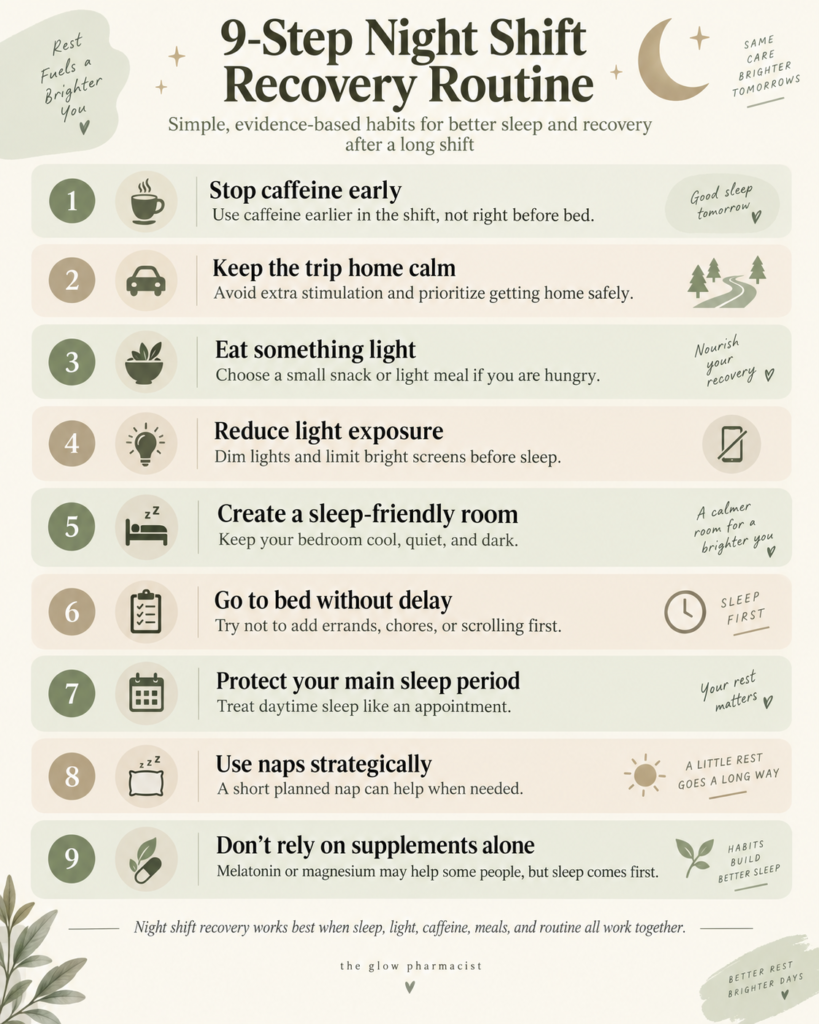
Here is a realistic approach:
- Stop caffeine several hours before the end of your shift.
If you use caffeine for alertness, keep it earlier in the night so that it is less likely to interfere with daytime sleep.
- Keep the trip home calm.
Avoid unnecessary stimulation, bright screens and anything that makes you feel more alert than you need to be.
If you are dangerously sleepy, however, safety comes first. Do not rely on sunglasses or other circadian strategies if they make driving less safe.
- Eat something light if you are hungry.
You do not need a large breakfast before bed.
A small meal or snack with some protein and carbohydrates may be enough to prevent hunger from waking you later.
- Reduce light when you get home.
Dim the lights, limit bright screens and make your bedroom as dark as realistically possible.
- Keep your bedroom cool, quiet and protected.
Blackout curtains, an eye mask, earplugs or white noise can all help create better conditions for daytime sleep.
- Go to bed without unnecessary delays.
Laundry, errands and scrolling can usually wait.
The longer you stay awake after your shift, the harder daytime sleep may become.
- Protect your main sleep period.
Treat it like an appointment.
Silence notifications, let the people around you know when you are sleeping and avoid scheduling unnecessary commitments during that time.
- Use naps strategically if needed.
A short nap before your next shift may help restore alertness, especially if your main sleep was shorter than planned.
- Do not expect supplements to fix sleep deprivation.
Melatonin or magnesium may be useful in specific situations, but neither can replace adequate sleep or correct poor caffeine and light timing.
Pharmacist Takeaway
The best night-shift recovery routine is usually not the most complicated one.
Protect sleep, manage light, time caffeine carefully, eat simply and give your body the best possible chance to recover before the next shift.
When Is Night-Shift Fatigue More Than Just Normal Tiredness?
Feeling tired after a night shift is expected.
But there is a point where persistent sleepiness deserves more attention.
If you regularly struggle to stay awake during work, feel dangerously sleepy while driving home, or cannot get enough restorative sleep even when you have the opportunity, it may be more than ordinary shift-related fatigue.
Some people develop shift work disorder, a circadian rhythm sleep disorder linked to work schedules that overlap with the usual sleep period.
Common signs can include:
Difficulty falling asleep or staying asleep when you need to sleep during the day.
Excessive sleepiness while working at night.
Persistent fatigue that continues even when you are trying to rest properly.
Problems with concentration, memory or alertness.
Repeated drowsy driving or near-miss accidents.
If these problems are ongoing, it is worth speaking with a healthcare professional rather than simply adding more caffeine or supplements.
Other conditions can also worsen fatigue, including sleep apnea, anemia, thyroid problems, medication effects and mood disorders.
Pharmacist Takeaway
Night shifts are tiring, but severe or persistent sleepiness should not be ignored.
If fatigue is affecting your safety, work performance or ability to function outside work, it deserves proper evaluation.
Final Thoughts
Night shifts are demanding because they ask your body to stay awake and sleep at times that do not naturally match your circadian rhythm.
There is no single trick that completely fixes that.
But a few simple habits can make recovery more manageable.
Protect your main sleep period.
Use light strategically.
Keep caffeine earlier in the shift.
Use naps when they genuinely help.
Eat and hydrate in a way that supports — rather than disrupts — sleep.
And be cautious with supplements that promise to “fix” night-shift fatigue.
Most importantly, recovery does not need to look perfect.
A realistic routine that you can repeat consistently is more useful than an elaborate routine you will abandon after a few shifts.
From a pharmacist’s perspective, the goal is not to force your body to adapt perfectly to night work.
It is to reduce unnecessary strain, protect sleep as much as possible and recognize when fatigue has become too severe to simply push through.
Sources & Further Reading
- Wright KP, Abbott SM. Treatment of Extrinsic Circadian Rhythm Sleep Wake Disorder: An American Academy of Sleep Medicine systematic review, meta-analysis, and GRADE assessment. Journal of Clinical Sleep Medicine. 2025.
- American Academy of Sleep Medicine. Management of Shift Work Disorder. Clinical Practice Guideline. 2025.
- Centers for Disease Control and Prevention, National Institute for Occupational Safety and Health (NIOSH). Training for Nurses on Shift Work and Long Work Hours. Modules on sleep, caffeine, napping, light exposure and coping with night shifts.
- Shakhloul M, Amer A, Zekry M, et al. Effective Interventions for Reducing the Negative Effects of Night Shifts on Doctors’ and Nurses’ Health and Well-Being: A Systematic Review. Cureus. 2025;17(5):e83385. doi:10.7759/cureus.83385.
- Wu Y, Huang X, Zhong C, et al. Efficacy of Dietary Supplements on Sleep Quality and Daytime Function of Shift Workers: A Systematic Review and Meta-Analysis. Frontiers in Nutrition. 2022;9:850417. doi:10.3389/fnut.2022.850417.
- Rajaratnam SMW, Howard ME, Grunstein RR. Sleep loss and circadian disruption in shift work: health burden and management. Medical Journal of Australia. 2013;199:S11–S15.
This content is for educational and informational purposes only and is not a substitute for individualized medical advice. If excessive sleepiness, insomnia or fatigue is persistent, affects your ability to work safely, or makes driving unsafe, speak with a healthcare professional.